

AI with a Human Touch: Why Twindo Doesn’t Let Machines Do It All
Every AI-powered platform promises instant outputs, full automation, and fewer humans. When it comes to architecture, construction design, and reality capture workflows, that often translates to “scan a space and get your AI-generated as-builts in seconds.”
Sounds great in theory. The issue is that “instant” and “usable” are not the same thing.
Automated outputs can look impressive at first glance but often still have missing architectural elements, inaccurate measurements, or messy (or non-existent) layer organization that creates headaches once real design work starts. Anyone who’s worked with fully automated outputs has probably had to start from scratch due to the quality of the output.
That’s why Twindo takes a different approach. We use AI throughout our workflow because it genuinely makes capture and processing faster. But we also integrate trained human experts in the loop because we know that quality deeply matters, especially when teams are making real project decisions from their CAD/BIM models.
Where AI Actually Improves As-built Workflows
AI helps accelerate scanning, spatial data processing, and draft generation so teams can create design-ready as-builts faster and reduce repetitive manual work.
To be clear: AI is incredibly useful in reality capture workflows. Instead of spending hours manually pulling tape, teams can now scan environments with an iPhone or iPad Pro and generate spatial data much faster than traditional field measuring methods.
At Twindo, AI helps us:
- Capture spaces faster than hand measuring
- Enhance the raw scanning data to correct for drift, lighting issues, and capture inconsistencies
- Process large amounts of spatial data quickly
- Generate draft previews faster
- Reduce repetitive modeling and documentation work
That speed matters. It also helps us to drive more consistency and reliability in Twindo’s Scan to CAD, Plan to CAD, and Point Cloud to BIM workflows.
As Oleksandra Fohol, Twindo’s Director of Operations, explains:
“AI is a fantastic efficiency and augmentation tool to the process, but it still does not yet provide the level of consistency, quality, and accuracy that our customers expect from as-builts within their workflows. And honestly, that’s the key distinction of Twindo.”
There’s a big difference between generating a model quickly and generating one a team can confidently build, design, estimate, or coordinate from.
How Our Human CAD/BIM Experts Improve CAD and BIM Workflows
Human QA for CAD/BIM helps improve measurement accuracy, layer organization, and overall usability within real CAD and BIM workflows.
A lot of companies are racing toward fully automated outputs. Twindo’s philosophy is different: reliability matters most.
That’s why Twindo’s operations team reviews and quality-checks deliverables before they’re finalized. It’s a tradeoff in turnaround time (but still faster than doing it yourself), yet it dramatically improves consistency and usability.
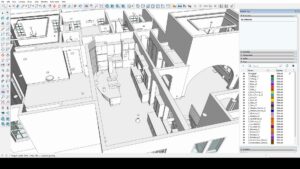
Because if a model is missing walls, placing elements on incorrect layers, or introducing measurement issues, someone eventually pays for that downstream. Usually with extra revisions, rework, or another site visit nobody wanted to schedule.
According to Fohol:
“Reliability in these aspects drives trust. If customers can’t trust us to provide accurate measures, consistent models, and dependable delivery timelines, then we’ll lose the right to help them grow their businesses.”
That human QA process helps validate:
- Measurement accuracy
- Structural and geometric consistency
- Layer organization
- Element recognition
- Overall model completeness
It also helps catch the kinds of weird inconsistencies AI still struggles with today. If you’ve ever seen AI generate six fingers on a hand or stairs that lead nowhere, you already understand the broader issue: AI is powerful, but it still misses things humans immediately notice. The same applies to spatial data.
Instant Outputs vs Design-ready As-builts
Instant CAD previews can support estimation and visualization, but production-ready as-builts still require additional validation and quality assurance.
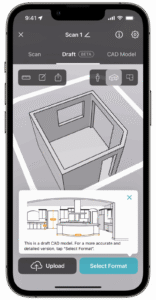
Twindo does offer fast automated outputs through Draft, an instant preview of a simplified CAD file generated immediately following a scan. They’re great for walkthroughs, early estimates, and helping clients visualize a space quickly. But Twindo is also very intentional about Draft being just that, rather than a final model.
As Fohol puts it:
“The level of development is extremely low, and the measurements are great for on-site estimation, but not precise or detailed enough for design-ready as-builts.”
That distinction matters because teams often assume “instant” means production-ready.
In reality, high-quality as-builts still require additional processing, validation, and QA, especially for workflows where precision matters. Twindo’s final deliverables are reviewed to meet LOD 200 standards because the goal isn’t just speed. It’s dependable, editable CAD files and reliable outputs.
Faster Only Matters If the Work Adds Up
One of the biggest misconceptions around AI-generated as-builts is that speed automatically improves the workflow. Sometimes it does. Sometimes it just moves the problem further downstream.
If teams have to spend hours fixing geometry, reorganizing layers, or double-checking measurements later, the “time savings” disappear pretty quickly behind incremental costs.
That’s why Twindo focuses on balancing automation with human oversight instead of treating them as opposites. The real goal is to eliminate tedious manual work without sacrificing the accuracy and consistency teams actually depend on.
The Future of Reality Capture Is Human + AI
The future of reality capture probably isn’t fully manual or fully automated. It’s somewhere in the middle.
AI is excellent at accelerating capture, processing data, and removing repetitive work. Human expertise still matters when it comes to judgment, quality assurance, and making sure the final output reflects the real-world conditions of the space. That balance is a huge part of how Twindo approaches reality capture for architecture and construction today.
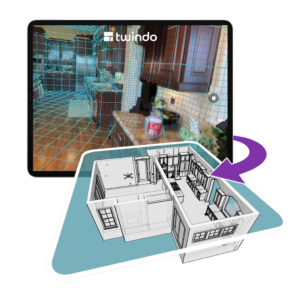
Learn more about Twindo Scan to CAD and how you can get accurate, editable as-built CAD/BIM models without measuring by hand or spending hours modeling.
FAQs
What does “human in the loop” mean for as-built workflows?
“Human in the loop” means AI helps accelerate scanning and model generation while trained professionals review and quality-check the final output before delivery.
Are fully automated as-built models accurate enough for design work?
Some instant as-built models can work for previews or estimation, but many still lack the consistency, detail, and reliability required for production-ready design workflows.
What is the difference between Twindo Draft and final as-built deliverables?
Twindo Draft provides a fast, automated preview for visualization and estimation. Final Twindo deliverables are fully processed CAD/BIM files in industry-standard formats that go through additional processing and human QA to achieve higher-quality, design-ready outputs.
Why does layer organization matter in CAD and BIM files?
Poor layer organization can create confusion during design and construction workflows. Correctly segmented layers help teams work faster and reduce cleanup time later.
Does AI replace architects, surveyors, or modeling teams?
No. AI helps reduce repetitive work and speed up capture, but human expertise is still essential for accuracy, interpretation, quality control, and decision-making.